
Trace the Dinuba Street Directory by Address
A Dinuba street search starts with a complete address, not a guessed name. The parcel system establishes situs, APN, assessment details, and a current recorder document. The deed index identifies parties to recorded instruments, not every person at the address. GIS adds touching parcels. Voter data has a separate purpose rule, and a historic directory is dated evidence. Each step keeps its source in the proper role.
- Verify the address. Check the full delivery address with the Dinuba Post Office information, then separate postal city from incorporated city or county jurisdiction.
- Find the parcel. Run the address in Tulare MPTS and record the APN, situs, and current recorder document number and date.
- Check the map. Open Tulare GIS, select the target polygon, and note touching parcels or a split or merger record.
- Open the document trail. Search the recorder kiosk by document number. Read grantor, grantee, legal description, and instrument type before searching earlier parties.
- Use voter sources within their limits. My Voter Status serves the individual. A street-wide file request needs an approved purpose, signed application, identification, and security terms.
- Add municipal records. Request permits, code files, or other releasable address records from Dinuba through City Hall.
- Look backward. Ask the library or genealogy room for a physical street section, then compare its date with deeds, newspapers, and released census schedules.
This produces a source-labeled trail: title parties, parcel changes, municipal work, and dated historical names. It cannot become a complete current household list.
Read a Dinuba MPTS Parcel Result
The Tulare MPTS Property Search is the main online entry for a Dinuba address. It is free and searches by fee parcel, assessment, or street address. Omit words such as Street or Road and use the directional form shown in the record. Terms must be two to twenty characters. MPTS has no owner-name search, so a known address or APN is the useful key.
The search surface is compact, but it carries the bridge to the county recorder. For a Dinuba street directory search, these are the captured controls and formats:
| Portal | Field | Type | Required | Options or format notes |
|---|---|---|---|---|
| MPTS | SEARCH BY | Choice menu | Yes | FEE PARCEL, ASSESSMENT, or STREET ADDRESS |
| MPTS | SEARCH TERM | Text | Yes | 2-20 characters; shorten street suffixes and use N, E, S, or W as shown |
| MPTS | Search | Action | After entry | Runs the selected search mode |
| GIS | APN | Parcel search | Alternative | Format such as 123-456-789; an address or place may also be entered |
| GIS | Layers | Map control | Optional | Tax Parcel, PLSS Section, and PLSS Township |
MPTS can show APN, assessment, tax-rate area, situs, property type, size, legal shorthand, values, exemptions, building details, year built, rooms, and the current recorder document and date. The inspected result omits owner and mailing names. A homeowner exemption can support an owner-occupancy inference, but neither its presence nor absence identifies everyone at the situs.
The MPTS search view used for Dinuba parcel research shows why the current document number matters in a title question.
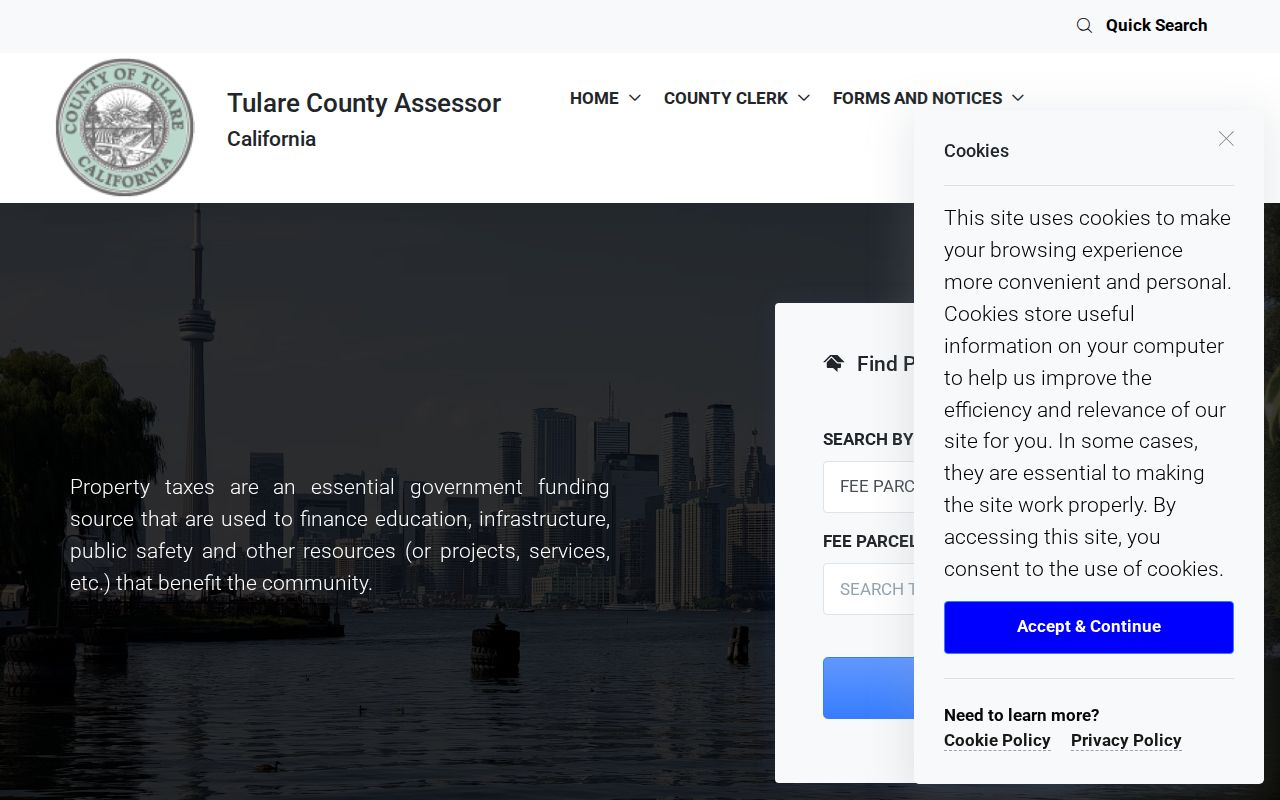
The bridge avoids a weak name guess. If web results lack owner detail, use the assessor counter or listed special research. MPTS remains a parcel finding aid, not a resident roll.
Dinuba Street Directory Records
Each custodian answers a different address question. MPTS and GIS are parcel keyed. The recorder is party and document keyed. Dinuba permits are request keyed. Historical directories use a name or street section only when a volume includes Dinuba. The voter file cannot become a casual address roll.
| Source | Search key | Best evidence | What it cannot establish |
|---|---|---|---|
| MPTS property search | Street address, APN, or assessment | Current parcel, characteristics, and recorder document link | Owner name, tax mailing name, or full household |
| Tulare GIS viewer | APN or address/place | Parcel boundary, adjacency, and cadastral change metadata | Household or owner-radius report |
| Recorder Tyler index | Party, document number/type, or book/page | Recorded parties and title instruments | Present occupancy |
| Dinuba permit or code file | Address, APN, date, or work type request | Work and applicant or owner at filing time | A complete resident list |
| Historic directory | Name or street section, if Dinuba is covered | Surveyed occupant or business at a publication date | Completeness or current status |
| Released census schedule | Enumeration geography and address | Household relationships for released years | Named households after 1950 |
| Authorized voter file | Approved purpose and requested extract | Registration fields allowed under California law | Casual block lookup or ballot choice |
APN and legal description are the strongest join points. MPTS can lead to a recorder image, and the same APN can narrow a permit request. Check a directory street heading against a map or census enumeration. Keep every name time stamped.
Trace Dinuba Owners by Grantor and Grantee
The Tulare recorded-document kiosk follows the MPTS document number. Name and Document Type Search begin in 1960; known Document Number Search reaches 1949. Map book/page and advanced paths are also available. Enter exact names last name first without punctuation. The help supports required or excluded terms, wildcards, sounds-like, fuzzy, proximity, quotes, and alternatives.
Start with the latest document. A grantor conveys an interest; a grantee receives it. Match APN or legal description, date, and instrument type, then search the earlier grantee as a later grantor. A deed of trust, reconveyance, or lien is not automatically a sale or proof of residence.
Index images and copies are separate. Uncertified images are paid after checkout; certified copies use counter or mail routes. Lobby computers and microfiche help with older material. Staff can retrieve a known file but do not perform a title search. Copy instructions cover online, mail, and counter access. Recorder staff: (559) 636-5050.
- Parcel
- A mapped unit used for assessment and tax purposes. One address can relate to more than one parcel, and a parcel can change through a split or merger.
- Situs address
- The physical location of a parcel or improvement. It is not automatically a tax mailing address or a person’s residence.
- Legal description
- The deed’s formal land description, such as lot and block or township, range, and section. It remains useful when a street label shifts.
- Plat
- A recorded map of lots, blocks, streets, and easements. It can explain why an APN or street segment differs from a simple address list.
- Criss-cross directory
- A reverse directory arranged by street and house number rather than surname. It supplies a dated occupant clue only when the volume includes Dinuba.
Browse Dinuba Parcels in GIS
The Tulare County Public Parcel Search accepts an APN such as 123-456-789 or a one-line address or place. Turn on Tax Parcel, PLSS Section, or PLSS Township layers, then zoom until the parcel polygons and APNs are clear. Search, map, legend, layers, draw, basemap, coordinate, locate, home, and zoom tools are available. The popup can include APN variants, assessment, lot and block, area, map index, creating and terminating document numbers and dates, township, range, section, and links to MPTS, an assessor map PDF, and a map view.
For a street-by-street pass, click the target parcel, record the APN and document metadata, close the popup, and select each polygon that physically touches it. The viewer returns at most six suggestions or results, so a broad address phrase may need to be shortened. It has no dedicated radius owner report. A circle, rectangle, or polygon can mark a study area, but measurement output is disabled and the drawing does not return names. The first three APN digits point to the assessor map book and the first six point to book and page, a useful Dinuba shortcut when a map reference is available.
Note: A GIS polygon groups land records; it does not convert parcel adjacency into a list of people, occupants, or household ties.
Request Dinuba Permit History
Dinuba’s public permit path is not an anonymous address-history database. Planning and Development handles current submissions and department questions, while the Dinuba City Clerk is the route for a targeted California Public Records Act request for older permits, code cases, business-license material, or other releasable address-keyed files. A useful request names the situs, APN if known, record class, work type, and date span. The municipal request form asks for the requester’s name, mailing address, phone, a specific description, preferred format, and delivery choice.
The Dinuba permits and applications page shows the municipal entry point for permit forms and related local services.
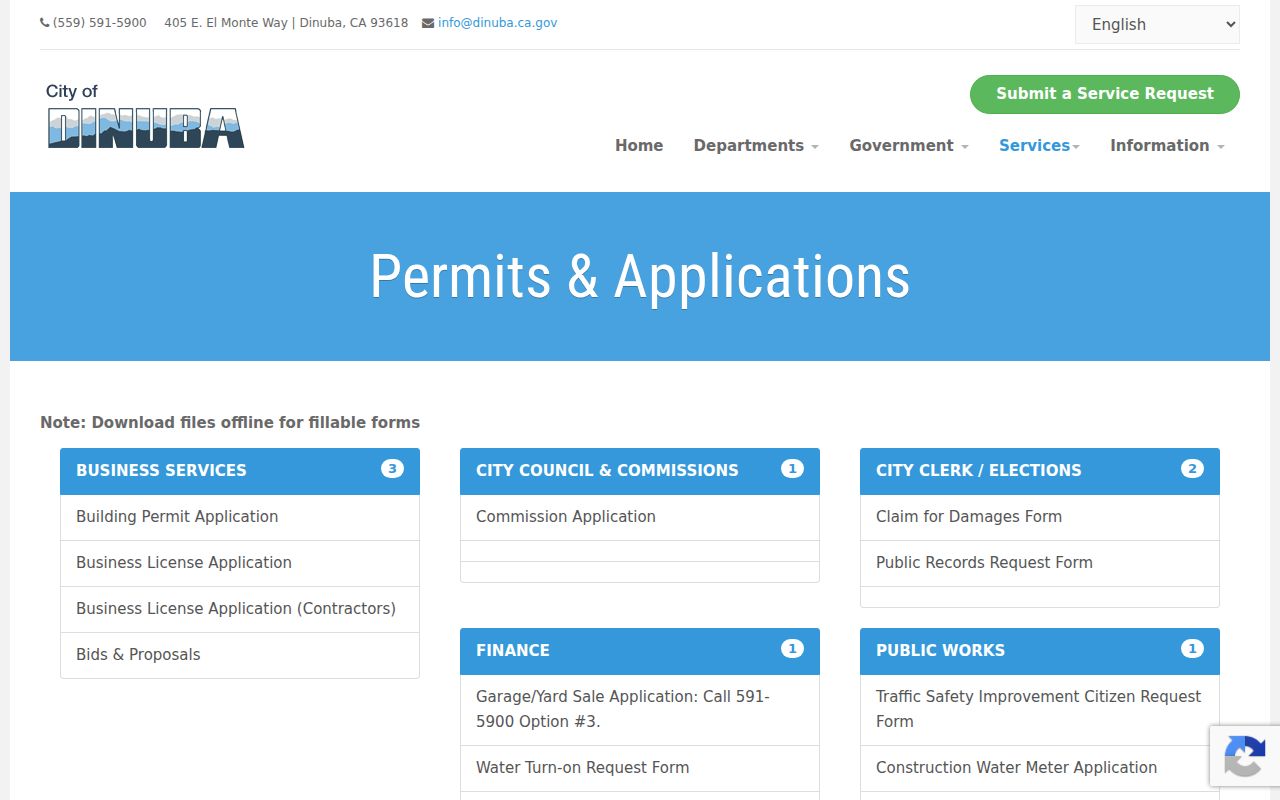
The image points to a form route, not a public list. Dinuba’s policy gives a disclosure determination within ten days, charges $0.10 per paper page, and uses direct cost for other media. Fulfillment may be by mail, fax, email, or inspection. Some permit submittals can be emailed, though hard copies may still be required. The ePermits route is account oriented and currently says residents may use it only for reroof permits, so it should not be described as a complete address history.
Planning and Development is at 1088 E. Kamm Ave. and lists (559) 591-5921, permit questions at (559) 591-5924, and weekday 8-5 hours. A permit can date work or identify an applicant at filing time. It does not prove that the applicant occupied the parcel or that every later change is in the file.
Dinuba's 1949 and 1960 Recorder Cutoffs
Dinuba’s online recorder trail is asymmetric. A known document number can be searched from 1949, while fresh name and document-type searches begin in 1960. The county recorded-document search guidance explains the index limits and spelling advice. That difference matters when a 1950s instrument appears in a current parcel record. A researcher may reach it by number, then move backward through the legal description. A name-only search for the same instrument may fail online and require a lobby terminal, microfiche, or a counter request.
The townsite was deeded to Southern Pacific in 1888 and Dinuba incorporated in 1906. Early land and voter records therefore cross county and state custodians rather than beginning with city files. Newspapers reach back to 1907 and 1909 in the verified library runs, while county directories appear at selected years from 1888 through 1958. These dates are clues to the right shelf or office, not a claim that every Dinuba street appears in every volume.
Note: The current MPTS document bridge can expose an older deed number that a new online name search cannot reach.
Read a Dinuba Historic Address Book
A historic address book adds a past household layer, but it must be inspected as a physical source. The Tulare Public Library Genealogy Room inventory lists countywide volumes from the 1888 business directory, 1904-05 resident and business directory, 1908-09 regional telephone directory, selected 1930s volumes, and R.L. Polk’s Tulare County runs from 1934 through 1958. Each title must be checked for town coverage. A county title alone does not prove that Dinuba is present.
- Photograph or transcribe the title page, publisher, and publication year.
- Check the geographic list for Dinuba and note whether rural routes are included.
- Record the abbreviation key before reading names or street headings.
- Test the alphabetical and street-order sections with more than one known address.
- Keep the printed date beside every name so a historic clue is not mistaken for a current record.
A typical Polk method may show a surname, given name, spouse notation, residence, and a reverse section ordered by street and house number. That is a method note, not a confirmed Dinuba sample. The Dinuba city directory collections page carries the broader shelf discussion. For the historical side of a Dinuba street directory, the key question is whether the volume actually names the Dinuba area and contains a street section.
Access begins at the Dinuba Branch Library, 150 S. I Street, with its published Tuesday through Friday schedule and BMI Digital Reel access. The Tulare County Library research route leads to the Annie R. Mitchell History Room, newspaper holdings, and databases. When a street section is not digitized, ask the county genealogy room, a state library, a family-history film service, a national census archive, or a map catalog for the relevant physical, film, census, or Sanborn route. No confirmed digitized Dinuba directory page was located.
Note: A missing name can reflect coverage, a missed canvass, a move, or a changed street reference; it does not prove absence from Dinuba.
Follow the Dinuba Street Grid
Dinuba’s address pattern changes with its history. The railroad-era core runs northwest and southeast beside the former Southern Pacific alignment. Beyond roughly Alta, El Monte, College, and Vassar, streets turn toward a cardinal north-south and east-west pattern. El Monte Way is the main east-west connector, Alta Avenue runs north-south, and Tulare Street with the H through M streets shapes the downtown grid. Newer areas use longer blocks, loops, and cul-de-sacs. This diagonal-to-cardinal change can make a straight street-name assumption misleading.
The Dinuba Planning and Development information helps place permit and land-use questions in the city’s development context.

A planning source can help explain why a parcel, road, or project sits where it does, but it does not replace the parcel map or deed. No authoritative citywide street-renumbering, street-renaming, emergency-address, or ZIP-realignment year was verified. If an old directory and a current address do not match, compare the plat, legal description, Sanborn catalog, planning map, and newspaper before assuming a renumbering.
The postal label adds another local caution. A 93618 Dinuba mailing address can cover rural postal territory, so USPS delivery geography is not a city-limit test. Use the full address in USPS, then check parcel jurisdiction in GIS before sending a city request.
Dinuba Voter Data Has Limits
California My Voter Status is an individual self-lookup. It is not a name search for Dinuba and not a list of registrants on a street. The Tulare County voter-data request route can serve an approved file request, but the application asks for the applicant and beneficiary, contact details, represented organization, precise purpose, security plan, requested fields, shipping, a wet signature, and current driver-license or state-ID copy. An authorization letter may be required when a requester acts for another organization.
The authorized file may include names, residential or mailing addresses, contact and language fields, birth date, party, status, precinct, vote-by-mail status, and participation history where permitted. Driver-license and state-ID data, Social Security numbers, unique identifiers, and signatures remain confidential. Participation shows an election and method, never ballot choice. Protected voters, preregistrants, and Safe at Home participants are excluded. In-person approved requests are typically ready in one business day; mailed requests are generally ready the next business day. The county contact is (559) 839-2100, with payment by cash, check, money order, or card subject to the stated convenience fee.
California Elections Code section 2194 and Government Code section 7924.000 control disclosure. The application and related rules bar personal or private communications, harassment, redistribution without approval, and other uses outside the approved purpose. A personal voter can use the telephone status route, but a street researcher should not ask staff to disclose another person’s protected registration.
What a Dinuba Street Directory Cannot Show
An address-based Dinuba directory cannot supply every person connected to an address. The public MPTS result omits owner and mailing names. A deed identifies legal parties, not all occupants. A permit identifies a project, applicant, or owner at a filing date, not a full household. Utility, delivery, and DMV residence data are not open street sources. A tax statement address, a professional address, or a parcel label can be a useful lead while still being the wrong kind of address for a residence claim.
Privacy boundary. Use Dinuba address records for lawful personal research, family history, property history, civic records, or reconnecting. California stalking and harassment laws apply, and protected-address programs must be respected. Stop when a source is shielded rather than trying to reconstruct the hidden address.
California Safe at Home can provide a designated address, mail forwarding, a service-of-process agent, and confidential voter registration for qualifying survivors and threatened people. The program supports future address substitution, including certain deed uses, but it does not erase information already published. The Safe at Home program is a safety channel, not a general anonymity tool.
Source labels are the final safeguard. Mark each fact as situs, APN, recorded party, tax correspondence, permit applicant, historical occupant, business address, or personal voter result. That discipline keeps the Dinuba address trail useful without turning a parcel chain into an unsupported claim about a person.