
What a Dinuba Resident Lookup Can Confirm
A Dinuba resident lookup joins sources, each answering a different question. Parcel and deed records connect an address to an owner and transfer, but not every person who lived there. Court records show party roles, vital records establish events, and licenses or filings confirm public affiliations. The ordinary voter tool is for a person's own status, not a street list.
| Record | What It Confirms | Where | Access |
|---|---|---|---|
| Parcel and deed | Ownership, situs, transfer, and a possible tax-mail lead | Tulare MPTS and recorder index | Free search; paid image or copy |
| Voter status | A person's own registration status and election details allowed by law | My Voter Status or approved Tulare file request | Self lookup; full file restricted |
| Court record | Case number, party role, filings, hearings, and public disposition | Tulare Superior Court case search | Dynamic index; counter or mail copies |
| Vital record | Birth, death, or marriage event and the legal copy type available | Tulare County Clerk or CDPH | Authorized or informational; fee applies |
| Probate file | Decedent, personal representative, and lawfully visible heir or devisee trail | Tulare probate records, usually Visalia | Public case rules; sealed items excluded |
| SOS, FBN, or license | Business affiliation, true registrant, professional status, or public practice address | State and Tulare official lookups | Free index; custodian verifies details |
Start with the known fact: case number at court, death date with vital or probate custodians, address in parcel research, and a business clue at a state filing or license board. With only a name, normalize its forms and require two matching facts before calling a result the same Dinuba person.
Note: A parcel profile can locate a document trail, but it cannot turn a titled parcel into a complete household list.
Separate Dinuba Namesakes by Stable Number
Dinuba records may use middle initials, compound or hyphenated surnames, maiden forms, or diacritics. Search exact, then simplified forms when allowed. Preserve name order. A similar surname is not proof of family or residence.
Use a parcel, recorder document, court case, entity, or license number as a pivot. Label each address as situs, tax mail, business, practice, agent, court service, or postal. A 2018 directory and 2026 license describe different moments.
Match rule. Keep a small comparison grid with the exact name, variant, source date, address type, stable identifier, and one second matching fact. Reject a candidate when a stable identifier or event date conflicts.
Verify One Dinuba Resident Across Records
For a one-person Dinuba resident lookup, define the question first. A parcel connection, court identity, and adoption-family request need different paths.
- List name forms, approximate date, city connection, and the lead source. Include a former surname or middle initial when lawfully known.
- If an address is known, run the Tulare MPTS property search by Street Address, Fee Parcel, or Assessment. Capture the APN and current recorder document number.
- Run the Tulare court party or business-name path with variants. Record case number, role, filing year, division, and caption.
- Use a matching vital, probate, license, or entity record to test identity, then request the identified document and mark its access type.
A Dinuba resident lookup can produce a lead without producing a document that establishes identity. Record type and access purpose control what can be ordered.
- Docket
- A docket is the running list of filings, hearings, and actions. It proves an event was recorded, not that every allegation is true.
- Index versus image
- An index is searchable metadata such as party, date, type, and number. An image is the scanned instrument or court paper and may require paid or in-person access.
- Certified copy
- A certified copy is an attested custodian copy for a use requiring official proof. It is not a screenshot or informational vital copy.
Read a Dinuba Court Index First
The Tulare Superior Court case search is a county system, not a statewide California trial-court party search. It supports case-number and party or business-name paths, with category and year narrowing where offered. Field order, coverage, and result count are dynamic. No fixed cap was exposed, so narrow by known year, division, and case type.
Compare the caption and role with the known person, then read the register as events. A complaint, charge, or allegation is not a judgment. Useful fields include:
- Case number, title, party name, role, filing date, division, category, department, and status where displayed.
- Register-of-actions entries, hearing dates, document titles, minutes, and public disposition information.
- Calendar, register, or document-image links only when remote access rules permit them.
- Omissions for sealed, juvenile, adoption, confidential parentage, protected-identifier, and some family material.
The result screen can identify a case without revealing the paper behind a docket line. Match the case number and role before asking a clerk to retrieve anything.
Note: A docket entry proves an event was filed, while the attached paper may require a separate viewing or copy request.
The Tulare court viewing and copying policy shows how the online result connects to counter and mail access.
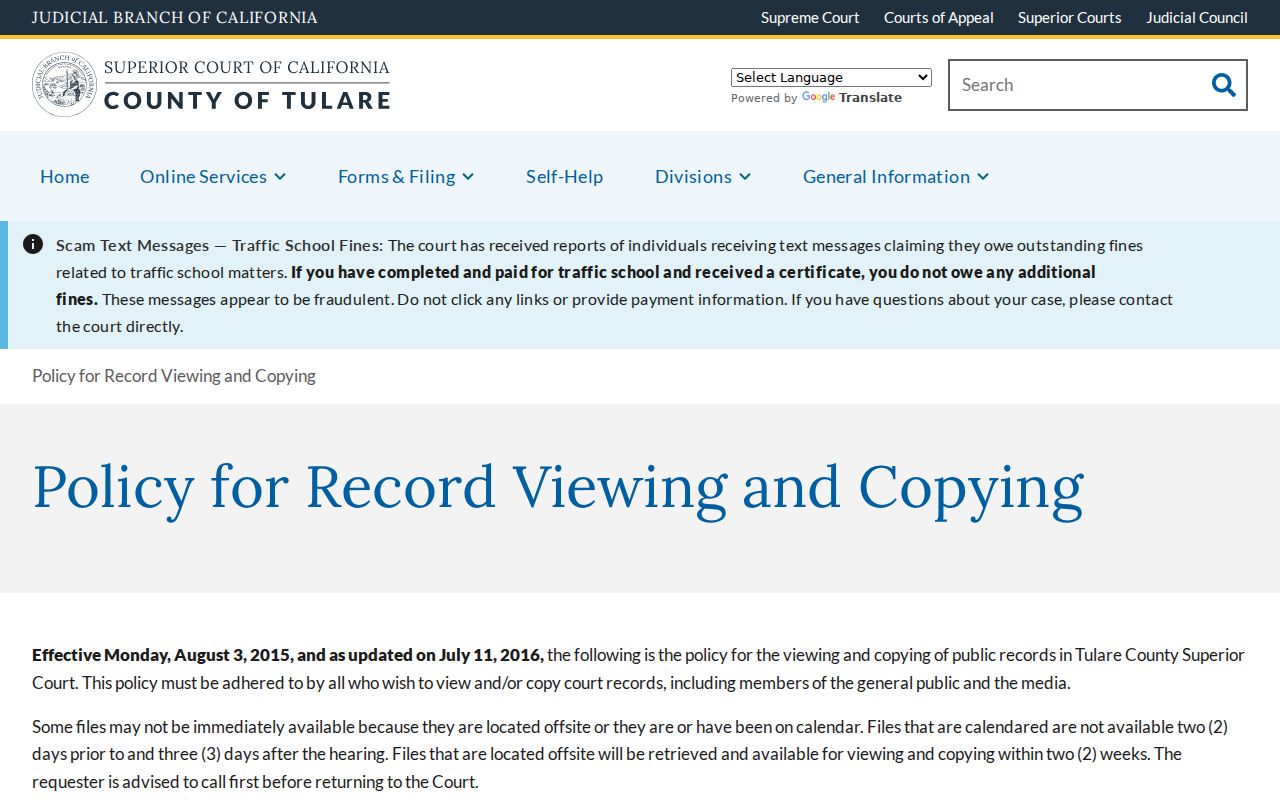
The policy separates remote records, counter viewing, and requested copies, so an index is not mistaken for a complete case file.
Dinuba Court Access for a Resident Lookup
Dinuba Division, 640 S. Alta Ave., handles criminal, traffic, family, Department of Child Support Services, and assigned north-county small-claims work. It is open Monday, Wednesday, and Thursday, 8 a.m. to 4 p.m., closed Tuesday and Friday.
The official Dinuba Division listing gives the branch route. Civil, probate, and much copy work go to Visalia, 221 S. Mooney Blvd. Visalia is (559) 730-5000; Dinuba is (559) 595-6400. The nearest courthouse is not always the custodian.
Access changes with the file and the timing of the request:
- In-person viewing requires identification and a viewing-log entry. Criminal, traffic, small-claims, and appeal files use service windows; civil, family, and probate files use designated tables.
- Calendared files are unavailable two days before through three days after a hearing. Offsite files may take up to two weeks.
- Mail copies require known case details and a not-to-exceed check. Family-law guidance lists $15 plus $0.50 per page and a self-addressed stamped envelope.
- Call before traveling when the index points to an older or offsite file. Staff retrieve known cases, not same-name identities.
The Dinuba Division image is a routing check; the viewing policy supplies broader copy rules. Include division, case type, and hearing date.
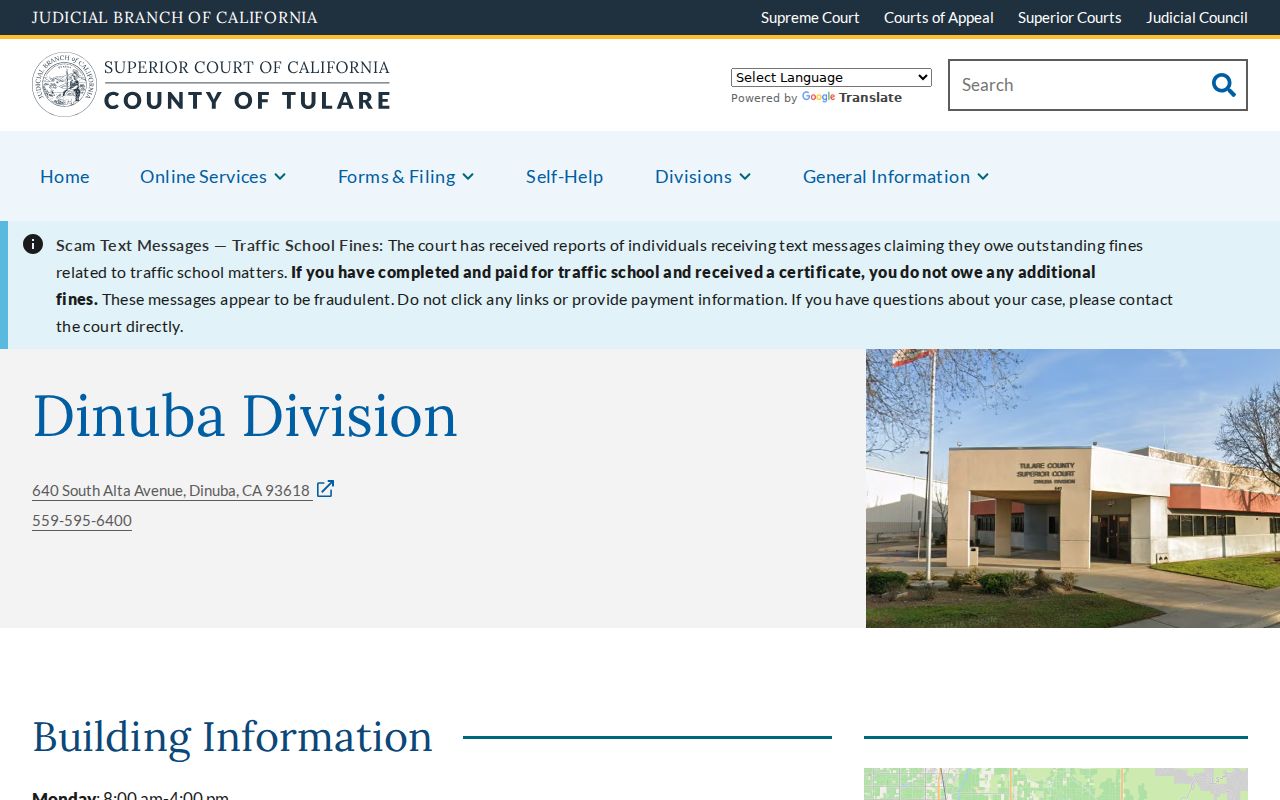
A correct branch and case number can prevent a referral or offsite wait.
Dinuba Vital Records for One Resident
California vital records do not follow a simple age rule. An informational copy confirms an event but is marked not valid to establish identity. An authorized copy requires a qualifying relationship or legal role and a sworn declaration. Confidential marriages are narrower still.
| Record | Custodian | Access type | 2026 fee |
|---|---|---|---|
| Birth | Tulare County Clerk or CDPH | Authorized or informational | County $34; state $31 |
| Death | Tulare County Clerk or CDPH | Authorized or informational | $26 |
| Public marriage | Tulare County Clerk or CDPH | Authorized or informational | $19 |
| Confidential marriage | Issuing county | Spouse or court order | $19 |
| Divorce | Superior Court; CDPH certificate | Court file or state abstract | $18 state certificate |
Tulare County orders are in person or by mail; an authorized third-party service may add a fee. Room 105 accepts photo ID. Mail needs the form, fee, and notarized sworn statement for an authorized copy. County birth copies from 1998 to the present are generally same day at the counter; pre-1998 copies next business day. Marriage mail takes one to five business days; a newborn record may take four to six weeks.
The CDPH 2026 vital-record fee table is the right check for the state route. The Tulare vital-record FAQ supplies the county ordering distinctions.
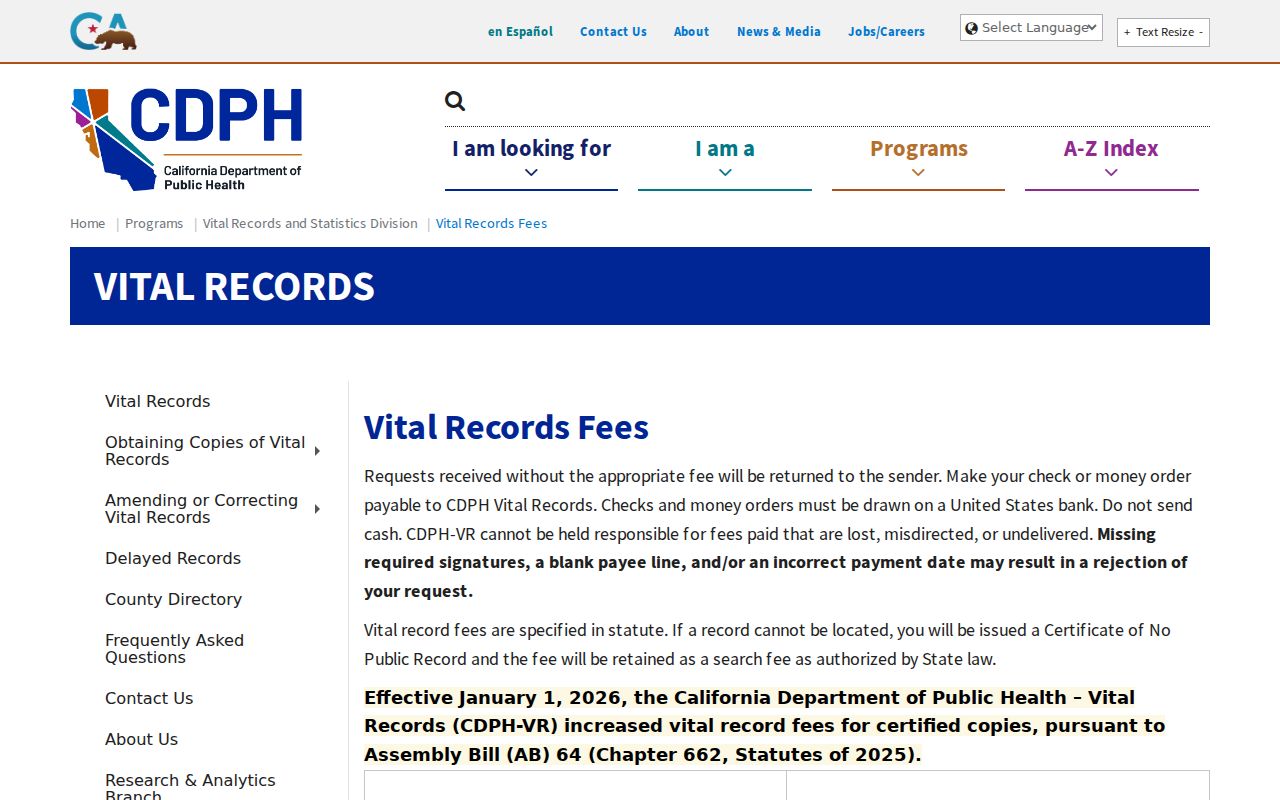
CDPH accepts mail rather than direct electronic orders, with a July 2026 average of four to six weeks. County service may be faster for a Tulare event; the state route helps when the county is uncertain.
Public and confidential marriage are different products. A returned license may need two weeks for processing, and copies may be ordered ten days after recorder receipt. An $18 CDPH divorce certificate is an abstract, not the Superior Court decree. A fee is also a search fee, so a no-record response may retain payment.
Note: County and state fees are search fees, so a no-record response does not necessarily return the payment.
Dinuba Heir and Adoption-Family Routes
An heir-focused search begins with a death record, then moves to the Tulare probate index and petition or order. A filing may identify the decedent, personal representative, and visible interested persons or devisees. Match the death date, known property, and relatives before accepting a same-name estate. Probate is a lawful family trail, not a shortcut around a sealed record.
Family trail: death evidence → Tulare probate case → petition or order → personal representative and lawfully visible heir information.
Adoption-family questions use California Department of Social Services post-permanency and adoptee-information consent and intermediary processes, including Consent for Arranging Contact form AD 902 and sibling waivers where applicable. Adoption files are not an open index. An original birth certificate requires a court petition showing good and compelling cause under Health and Safety Code section 102705.
For a former classmate, use a yearbook or school year, then check Dinuba newspapers, public organizations, or an obituary for a later surname or place. No official digitized Dinuba yearbook or local obituary index was verified, so a library or school inquiry is safer than a guessed address.
Dinuba Police Records for One Person
A court index and a Dinuba Police request answer different questions. The city channel handles traffic-accident reports, releasable crime reports, local-record checks, calls-for-service copies, fingerprints or Live Scan, VIN verification, citation copies, and animal records. Some reports cannot be released because victims, investigations, or confidential details are protected.
The 2026 to 2027 city schedule lists a $26 records search, $26 accident or investigation report, and $52 crime-report copy. Digital media is actual cost. Payment accepts cash, major card, check, or money order. Fingerprint walk-ins are Monday through Friday, 8:30 a.m. to 2:30 p.m., subject to availability.
The Dinuba records and fees notice gives the local service context.
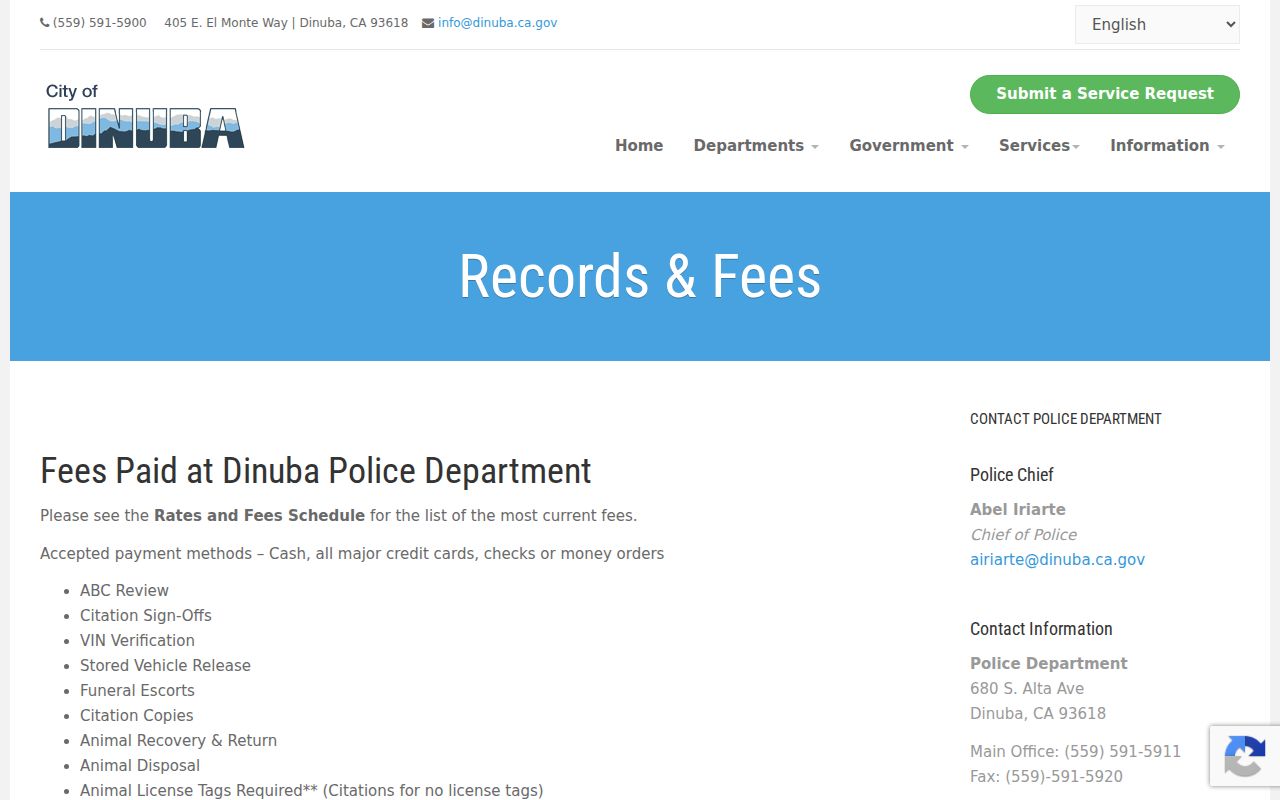
Use the city channel when the known event is local and the requested report is releasable. Use the court custodian when the issue is a case file, judgment, or hearing record.
Chain Dinuba SOS, FBN, and License Evidence
A business clue can make a Dinuba identity check more precise, but each register proves a different link. SOS bizfile starts with “Search by name or file number.” Filters include entity type, status, initial filing date, and begins-with search; results default to 500. Details may show entity number, status, addresses, agent, officers, managers, and filings. The result is informational, not certified; LLP and general-partnership copies use paper order.
Tulare's FBN search identifies the true trade-name registrant. Filing costs $45 for the first business or partner and $7 for each additional one; copies cost $3 for the first page and $1 for each additional page. Most filings expire after five years. Dinuba license requests should seek redacted records.
For the state entity step, use California SOS bizfile. For a county trade-name step, use the Tulare FBN search route.
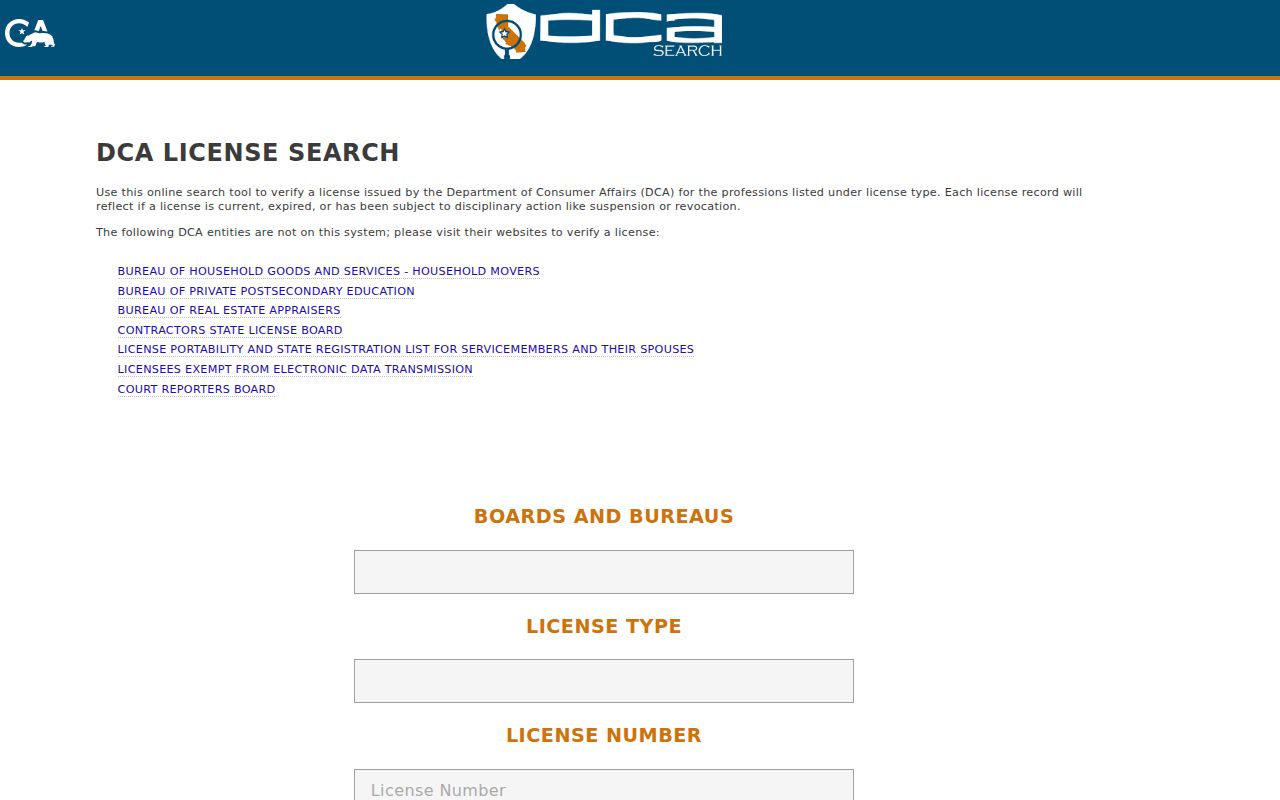
The California DCA license search adds professional status. It filters by board or bureau and license type, then accepts name, license number, city, or county. A result may show status, dates, public address, and posted discipline. Match the license number and date. A practice address is not a home address.
Audit the chain in this order:
- Confirm the entity and status in SOS bizfile, noting entity number and filing date.
- Check Tulare FBN for the trade-name registrant and compare filing periods.
- Compare the Dinuba record or DCA license by name, number, site, and active dates. Ask the custodian to certify required details.
The California DCA license search screen makes the board, license-type, name, number, city, and county fields visible.
SOS, FBN, city, and license records can verify a public affiliation when each source's limits stay clear.
Privacy Boundaries for Dinuba Residents
California's My Voter Status is a self-lookup, not a name, street, or neighborhood directory. Full voter information is restricted under Elections Code section 2194 and Government Code section 7924.000. An approved file request needs a wet signature, purpose, security plan, exact data, and current identification. In-person requests are typically ready in one business day; mail requests the next. Participation history never reveals ballot choices, and driver's-license data, Social Security numbers, unique identifiers, and signatures remain confidential.
For any Dinuba resident lookup, Elections Code section 18109 and 2 CCR section 19004 restrict harassment, redistribution, private or commercial communications, and uses outside the approved purpose. A street-wide request is not a specific voter request. The California voter-file application lists requested fields and confidentiality acknowledgments. Safe at Home participants and preregistrants are excluded from ordinary extracts.
California Safe at Home supplies a designated address, mail forwarding, a service-of-process agent, and confidential voter registration. Government Code sections 6205 through 6216 support it, and section 6209.5 permits address substitution in certain deeds. It protects future address use, not information already published. Stop when a protected record appears.
Correct a source with its custodian: assessor for parcels, recorder for an index issue, court for a case, licensing board for a license, and Elections for your own registration. Removing a copy does not fix the source.
For a nonexempt Dinuba municipal record not online, the Dinuba City Clerk public-record route accepts a specific written request. Its policy lists a ten-day determination, $0.10 per paper page, and mail, fax, email, or inspection. Court files follow judicial rules, not an ordinary California Public Records Act request.
California DROP launched January 1, 2026, allowing one deletion request to more than 600 registered data brokers. Brokers began processing August 1, check every 45 days, and generally delete matches within 90 days, subject to exceptions. The California DROP service provides tracking. Use data minimization and do not promise universal erasure.
Lawful personal use. Use a Dinuba search for personal, lawful research, family history, civic records, or a documented transaction. Do not use a record to stalk, harass, intimidate, or expose a protected address. California stalking law, including Penal Code section 646.9, makes safety and source limits part of the search.