
Dinuba City Directory Holdings
Tulare Public Library's Genealogy Room has the strongest posted shelf list for countywide directories. The Tulare directory inventory names the titles and years in the shelf list. A county title can include Dinuba, but inclusion must be checked volume by volume. The table separates a verified physical holding from the question of whether a particular edition actually canvassed Dinuba.
| Collection | Years | Where Held | Access |
|---|---|---|---|
| Tulare County Business Directory | 1888 | Tulare Public Library Genealogy Room | Physical inspection; verify Dinuba coverage |
| County Business/Resident Directory | 1904-05 | Tulare Public Library Genealogy Room | In person; check the town list |
| Regional Telephone Directory | 1908-09 | Tulare Public Library Genealogy Room | In person; six-county region |
| Lindsay City & Tulare County, and Tulare City & County | 1930-31; 1932-33 | Tulare Public Library Genealogy Room | In person; confirm Dinuba pages |
| R.L. Polk's Tulare County | 1934, 1936, 1937, 1939, 1941, 1942-43, 1944, 1947-48, 1950, 1952, 1953-54 | Tulare Public Library Genealogy Room | In person; likely best run to inspect |
| Polk's Tulare-Visalia and Polk's Tulare County | 1955; 1956-58 | Tulare Public Library Genealogy Room | In person; verify Dinuba coverage |
The run is intermittent rather than annual. The inventory does not establish a complete Dinuba sequence, a digital page set, or a final local publication year. It also does not support treating later Polk's Tulare City titles as Dinuba volumes; the listed towns for those books do not name Dinuba. Every useful citation should preserve the volume title, publisher, year, and town coverage checked.
Which Dinuba City Directory Runs Fit
A book called “Tulare County” is a research lead, not proof that a Dinuba household appears inside. Countywide publishers could vary their geographic reach, and a regional telephone book may list only selected towns or subscribers. The physical inspection should begin with the title page and the explanatory matter, not with an assumed surname hit.
Record the publication year, publisher, towns named in the geographic table, and every section present. Then test several known Dinuba streets and a few business names. That test shows whether the volume carries an alphabetical list, a street-order list, rural routes, or a separate business section.
- Transcribe the title page, publisher, year, and coverage statement.
- Search for “Dinuba” in the town or place index before relying on an entry.
- Test street names and house numbers in any reverse section.
- Note whether businesses and rural routes are indexed separately.
- Copy the volume's abbreviation and symbol key before reading marks.
Note: A missing volume year can reflect a shelf gap or publication gap, not a gap in Dinuba's local history.
Dinuba Library Access for Historical Directories
The Dinuba Branch Library, 150 S. I Street, is the local doorway to Tulare County Library resources. Its direct phone is (559) 595-7195. The published schedule is Tuesday 10 to 1 and 2 to 6, Wednesday 10 to 1 and 2 to 7, and Thursday and Friday 10 to 1 and 2 to 6. Staff can point researchers toward local-history help, newspaper access, and the Annie R. Mitchell History Room referral path.
The branch is not presented as the place where every county directory is shelved. Its value is the access channel: library staff, BMI Digital Reel for historical Tulare County newspapers, and AtoZ Databases for a current home and business directory through library access. The historical shelf list itself is tied to the Tulare Public Library Genealogy Room, so call ahead there before planning a long inspection session.
The branch's building and location record anchor Dinuba research. A local library presence does not turn a historical volume into a complete residents directory; it gives the Dinuba city directory search a custodian and a practical next call.
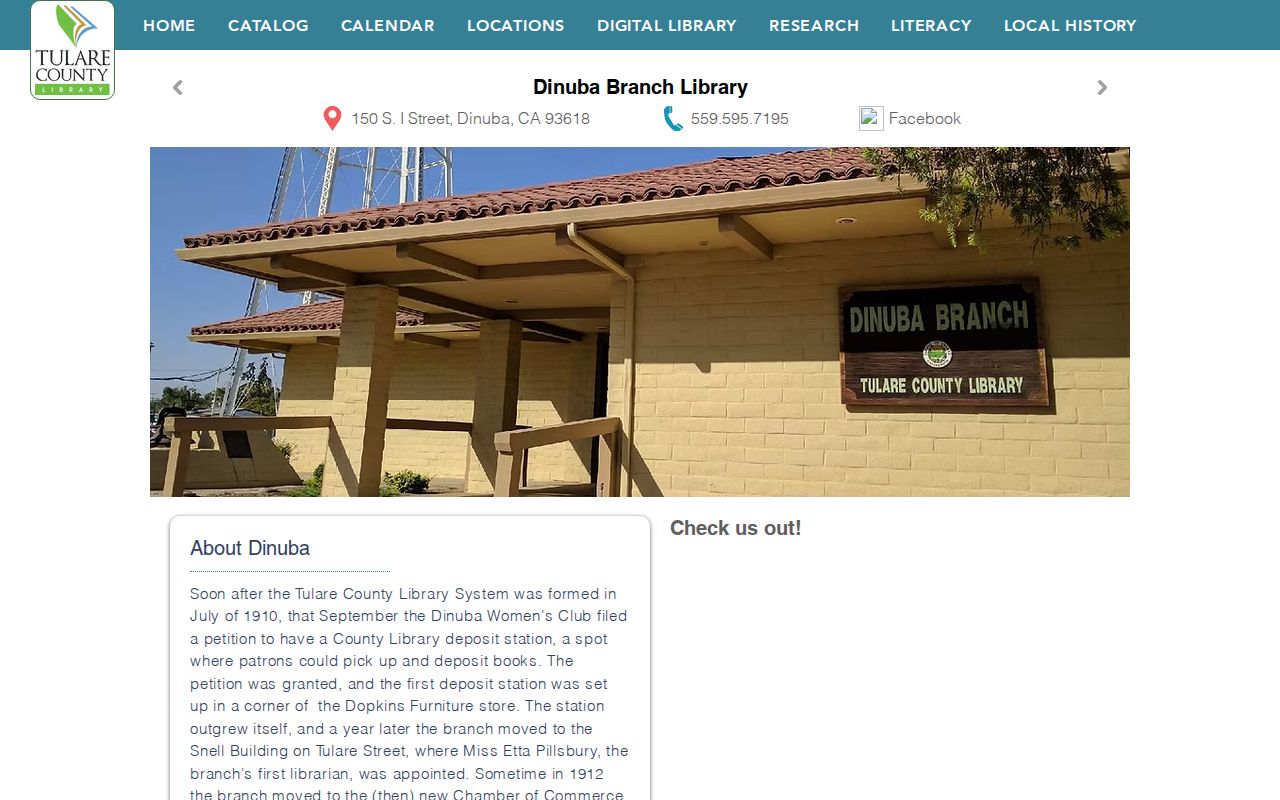
The Dinuba branch can connect a name search with local newspapers and county research tools, while the Genealogy Room remains the confirmed route for the listed physical directory holdings.
What a Dinuba City Directory Entry Shows
No local sample entry was confirmed in the research. The field inventory that follows describes what a typical Polk-style volume may print, not a claim that every Dinuba edition contains every field. Preserve the original spelling and punctuation. A surname with a middle initial, compound form, or diacritic may need more than one search pass.
Read the alphabetical entry first, then check for a street-order section in the same book. A person may appear under a principal household name, a spouse may be shown in parentheses, and a widow notation may be the clue that connects one edition to a newspaper or probate record.
| Name | Exact surname, given name, or initials as printed. |
|---|---|
| Spouse or widow notation | A spouse in parentheses or a widow marker may connect family members across years. |
| Occupation and business clue | Historical work and business references can help separate namesakes. |
| Residence or business address | House number, street, and a separate business address where printed. |
| Tenure mark | A symbol may signal ownership or another tenure category; use the volume's own key before interpreting it. |
| Cross-reference or telephone | A “see” note, moved or deceased notation, or telephone listing may add a time marker when present. |
- Criss-cross directory
- A reverse section arranged by street and house number rather than by surname. Its presence and run must be checked in each physical volume.
- Householder index
- An alphabetical list centered on principal householders or listed occupants. It is not a guaranteed list of every person in a home.
- Abbreviation key
- The volume's own explanation of short forms and symbols. Photograph or transcribe it before treating a mark as a fact.
Trace a Dinuba Household by Directory Year
A useful household trail pairs a directory year with the nearest released census schedule. Federal census schedules are public through 1950. The National Archives census route explains the 72-year release rule, while FamilySearch may provide film or transcription access for selected California records. Directories supply smaller year-to-year steps; census schedules supply household relationships and tenure at a wider interval.
- Start with a known surname in a listed volume, and prove that the volume includes Dinuba before treating the result as local.
- Pair the 1934, 1936, and 1937 Polk volumes with the 1930 census. Compare names, relationships, address clues, and the household's recorded tenure.
- Use the 1939, 1941, 1942-43, and 1944 volumes as the bridge toward the 1940 census. Mark a new street, spouse notation, or tenure symbol without smoothing over the original wording.
- Compare the 1947-48, 1950, 1952, and 1953-54 volumes with the 1950 census. The census year is an anchor, not proof that a directory entry from the same calendar year is identical.
- Flip to a criss-cross section when one exists. Street context can show nearby listed households, but it still reflects the publisher's canvass and not every person at an address.
- Use Dinuba newspapers, deeds, probate, or a death record to explain a change. Record every missing year as a gap instead of guessing whether a person moved or died.
A disappearance can mean a move, death, a missed canvass, a boundary change, or a surname change. The Census QuickFacts profile reports an average of 3.76 people per Dinuba household for 2020-24, a useful reminder that a principal name in a directory cannot stand for every member of a household.
Note: Census relationships anchor a household at one date; directory years fill some of the spaces between released schedules.
Dinuba Newspaper Runs Behind the Directory
The verified newspaper runs add the local time markers that a directory often lacks. The Tulare County Library newspaper holdings list identifies the Dinuba Advocate for 1907-15, the Dinuba Daily Sentinel for 1929-34, and the Dinuba Sentinel for 1909-2018. Gaps are possible. Holdings are on microfilm and BMI Digital Reel, so an entry that vanishes from a directory can be tested against a move notice, wedding, death notice, probate report, or business change.
The library's research doorway connects the newspaper run to broader databases and local-history assistance. Its research resources also point toward the Annie R. Mitchell History Room. A newspaper item is a lead, not a certified vital or court record, but it can supply the date and name variant needed for a stronger request.
The Tulare County Library research resources provide a route to those tools rather than a digitized Dinuba directory. They are especially useful when the physical county shelf has a missing year or when a family name changes form between editions.
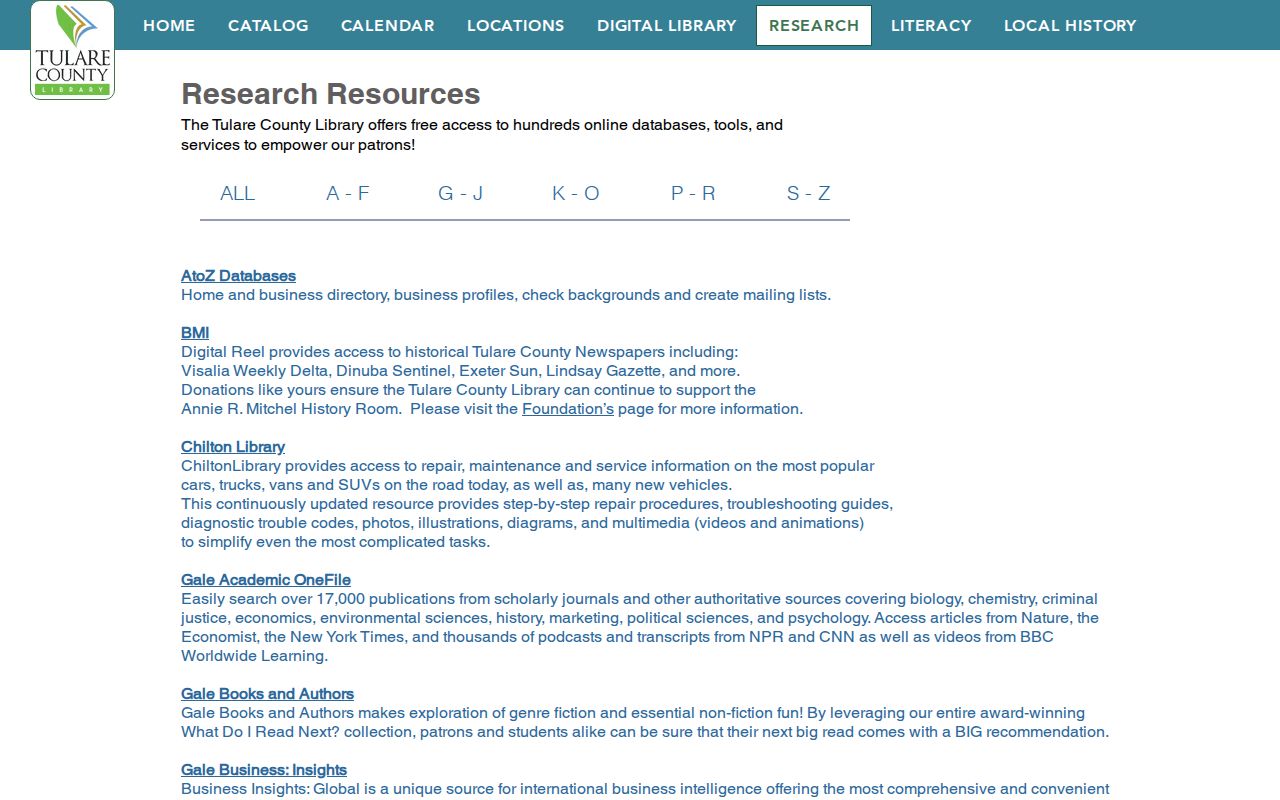
The library research collection can help bridge a directory gap with newspaper reels and history-room referrals, even though no confirmed digitized Dinuba entry was located.
Dinuba's Directory Shelf and the 1916 Library Fire
Dinuba's library history explains why local access matters. The first county-library station opened in 1910 after the Dinuba Women's Club petitioned for a deposit station. It began in a corner of Dopkins Furniture Store, moved to the Snell Building on Tulare Street, and later moved to the Chamber of Commerce. A Carnegie library followed in 1916.
The documented fire occurred in July 1916. The Chamber building and its library contents burned, and the new Carnegie building opened four days later. The loss is a library and Chamber story, not evidence of a courthouse fire or a countywide destruction of land records. Directory survival therefore still requires a shelf check, title-page citation, and confirmation of Dinuba coverage.
Sanborn Maps Beside Dinuba's Directory Volumes
The Library of Congress Dinuba Sanborn catalog lists editions from August 1891, August 1898, June 1903, August 1907, May 1925, and a corrected set from May 1925 through November 1944. The corrected 1925-44 item has 22 sheets, including North Dinuba, but it is cataloged rather than available online. Sanborn maps show building footprints, use, and street continuity. They do not name occupants.
Map evidence and historical directories answer different questions. A map can show whether a street line or building form fits an address, while a directory can offer a name, occupation, or household clue for a publication year. For current parcel work, move from the historic clue to the Dinuba street directory workflow, where an address can be checked against APN and recorder evidence.
Dinuba's record history crosses the railroad townsite, county land records, municipal files, newspapers, and printed directories. These dated points keep a historical volume search tied to the records that could actually exist for that period.
- 1888: James Sibley and W.D. Truxbury deeded 240 acres to Southern Pacific for a depot and townsite.
- 1891: The first Dinuba Sanborn edition listed in the Library of Congress catalog provides early street and structure context.
- January 6, 1906: Dinuba incorporated, shifting later municipal minutes and city records into a new local record layer.
- 1907-09: The verified newspaper runs begin with the Dinuba Advocate and Dinuba Sentinel, followed by the regional directory years.
- 1934-58: The posted inventory lists intermittent R.L. Polk county volumes, with Dinuba coverage still requiring inspection.
- November 1944: The corrected Sanborn range ends in the catalog description, without an online corrected image set.
Dinuba City Directory Gaps and Archive Routes
No confirmed digitized Dinuba directory entry, no confirmed reverse-directory run, no confirmed yearbook inventory, no confirmed local obituary index, and no confirmed online corrected Sanborn image set were located. There is also no verified local house-history guide in the research. These are research gaps, not proof that a paper volume, school book, obituary file, or map scan does not exist.
Dinuba High School, 340 E. Kern Ave., (559) 595-7220, is a possible inquiry point for yearbooks through the school or library, but no official digitized collection was found. The Alta District Historical Society's current authoritative holdings catalog and research fee were also not located. Ask for a named volume, year, and access rule rather than a broad request for every Dinuba resident.
Several archive routes can extend a historical directory search when the local shelf stops:
- Dinuba Branch and Tulare County Library: ask about BMI Digital Reel, local newspapers, AtoZ access, and referral to the Annie R. Mitchell History Room.
- Tulare Public Library Genealogy Room: use the posted directory inventory, call ahead, and confirm that the chosen volume is available for inspection and copying.
- California State Library: consult catalog and reference staff for city and telephone directory databases and Great Register originals or films.
- FamilySearch: check Great Register film and cemetery transcriptions; some digitized images may require a free account or a FamilySearch center or library affiliate.
- National Archives: use released census schedules through 1950, with the 72-year rule explaining why later identifiable schedules are not open.
- Library of Congress: use the Sanborn catalog and any public-domain map scans that exist; the corrected 1925-44 Dinuba set is cataloged but not online.
A directory search is strongest when every claim carries a year, volume, town-coverage check, and source type. A physical directory can place a name in a printed snapshot. A census, newspaper, deed, probate file, or map can then test what that snapshot means without turning a gap into an invented fact.
Note: Keep a separate citation for each physical volume and archive route because each can answer a different question.