
Where Dinuba Neighbors Begin
A Dinuba block does not have one official resident roster. Each source answers a narrower question. The county parcel viewer shows the shape of land and the APN, or assessor parcel number, for each piece. The assessment search adds situs details and a current recorded-document link, but it does not expose an owner-name directory. The recorder index identifies parties to recorded instruments. City requests can reach releasable permit or code files, while civic contacts offer a human route without publishing household names.
| Source | What It Shows About a Block | Access |
|---|---|---|
| Tulare County Public Parcel Search | Parcel shapes, APNs, touching relationships, and cadastral details | Free online GIS viewer |
| MPTS Property Search | Situs, APN, current document, assessment, and building fields | Free address or APN search; no owner-name mode |
| Tulare recorder index | Indexed parties, recording date, document type, number, and book/page | Free index; paid images and copies, with counter or mail options |
| Dinuba City Clerk and PRA | Releasable city records such as permits, code files, and public actions | Written request, inspection, or requested delivery |
| California voter file | Only approved registration fields or a person's own status, not an open block list | Purpose-specific request under state law |
| Dinuba civic contacts | Organization contacts and joining routes, not household or member names | Official city Get Involved page |
Ownership and occupancy are different facts. A deed records a transfer, and an assessment record describes a parcel. Neither one lists every person who sleeps there, visits there, or shares a household. Dinuba's 2020-24 Census estimate of 3.76 people per household makes the gap visible: one titled parcel can stand for several people, while some people in the area will not appear in land records at all. A careful block search labels each result as a parcel, a recorded party, a historical entry, a civic contact, or a protected record.
Note: A block source describes a record or contact route rather than a complete Dinuba residents directory.
Mapping Dinuba Neighbors in GIS
The Tulare County Public Parcel Search accepts an APN in a format such as 123-456-789 or a one-line address or place. The viewer returns at most six suggestions or results, so a partial address can hide the parcel needed for a block study. Turn on the Tax Parcel layer before treating a colored shape as a parcel. PLSS Section and PLSS Township layers add legal geography, while Search, Map, Legend, Layers, Draw, Basemap, Coordinates, locate, home, and zoom tools help frame the view.
Use the adjacent-parcel process in a fixed order:
- Enter the complete Dinuba address or APN and select the target parcel from the limited result set.
- Zoom until parcel polygons and APNs are clear, then click the target and record its APN, map index, lot or block details, and any creation or termination document.
- Close the popup and select each polygon that physically shares a boundary with the target. A parcel across a street is nearby, but it is not a touching parcel.
- Repeat the popup review for every touching parcel. The popup may link to MPTS and an assessor-map PDF, but it does not produce a household list.
- Use the parcel identifiers to move from GIS to the assessment record and, when ownership history is the lawful question, to the recorder index.
- Use Draw for a visual circle, rectangle, or polygon only. Measurement output is disabled, and the viewer has no radius or buffer owner report.
An insider map-book tip helps with older parcel work: the first three APN digits choose the assessor map book, and the first six choose the book and page. The useful flow is address → GIS target → touching APNs → MPTS document → recorder instrument. When the question expands from the immediate block to every address along a named street, the Dinuba street directory carries the broader street-by-street chain.
Dinuba Parcel Records and Limits
MPTS is the county's public assessment search, not a people finder. Its visible choices are SEARCH BY Fee Parcel, Assessment, or Street Address, followed by a SEARCH TERM of 2-20 characters. For an address, omit words such as Street, Road, Drive, or Lane and use directional letters such as N, E, S, or W. The returned parcel can show APN, assessment, tax-rate area, current recorder document and date, situs, property type, acreage, area, legal shorthand, values, exemptions, building details, units, year built, bedrooms, baths, fireplaces, and pools.
- APN
- The assessor parcel number that ties the mapped polygon to the assessment record and helps bridge to recorded documents.
- Situs address
- The physical location of the parcel. It is not the same as a tax mailing address or a person's confirmed residence.
- Legal description
- The deed language that identifies land by lot, block, subdivision, or township, range, and section when applicable.
- Homeowners exemption
- A visible assessment clue that may support an owner-occupancy inference, but its absence proves no particular household fact.
The inspected MPTS result does not expose an owner name or owner mailing address. It covers a large current parcel roll, but a parcel profile remains a land record. Treat the current document number as a bridge, not as proof that the titled owner is a current Dinuba occupant. If an APN has been split, merged, created, or retired, GIS creation and termination metadata and assessor maps help explain the change before a recorded document is read.
Dinuba Neighbors and Ownership
Once a target or touching parcel has an APN, open its current recorder document number in the Tulare Tyler index. The recorder search is organized around parties and instruments, not a neighborhood radius. Name Search and Document Type Search begin in 1960, while a known Document Number Search reaches 1949. Map Book/Page and Advanced Search provide other pivots. Exact names are entered last name first without punctuation, and spelling variants matter.
A grantor is the party conveying an interest; a grantee is the party receiving it. Read the deed image or copy with the indexed date, document type, APN, and legal description. Then search the earlier grantee as a later grantor and match the legal description and date before moving backward. A deed of trust, reconveyance, or lien is a different instrument from a conveyance. The index proves that a recorded instrument exists, while the image supplies the signed legal document and its terms.
The county's online cutoffs shape the work. A 1955 deed can be reached by a known document number, but a fresh online name search will not reach it. Earlier material requires lobby computers, counter help, or microfiche. Uncertified images and copies carry charges, while certified copies are available by counter or mail. Staff can retrieve a known record, but they do not perform a title search or decide which namesake is the right one.
For a block study, stop the chain at the parcel question. Do not turn one current document into a claim about every person on the block. A legal owner, a past grantor, and a current occupant can be three different identities tied to three different dates.
Note: The 1949 document-number cutoff and 1960 name/type cutoff are different search doors, not one continuous online history.
Dinuba Voter Records and Block Limits
My Voter Status is an individual's self-lookup. It is not a name-by-street directory. Full voter information is purpose-restricted under Elections Code §2194 and Government Code §7924.000. A person seeking an authorized file must submit a detailed purpose, organization or affiliation information, a security and confidentiality plan, a wet signature, identification, and any authorization letter required by the county. Tulare County Registrar operations can be reached at 5300 W. Tulare Ave., Suite 105, Visalia, (559) 839-2100.
The Tulare voter-data request route is not a casual way to ask for everyone near an address. The application can cover an approved set of registration and election-administration fields, but the request must name the exact data and permitted use. A street of unidentified people is not a specific voter request. Approved extracts may include name, residence or mailing address, status, precinct, district, party, registration method, and participation history when allowed.
- Participation history can show an election and voting method, never the ballot choice.
- Driver-license or state-ID data, Social Security numbers, unique identifiers, and signatures stay confidential.
- Protected voters, preregistrants, and Safe at Home participants are excluded from ordinary extracts.
- Misuse, redistribution, private communications, and harassment are restricted by Elections Code §18109 and 2 CCR §19004.
That structure protects both the voter and the meaning of the result. A registration record can confirm an authorized election record at a point in time, but it cannot be used to fill the gaps in an ordinary Dinuba block search. A self-check is useful for the person who owns the record; it does not authorize a block roster.
Note: A voter status result helps an individual confirm registration; it does not turn a Dinuba address into a legal person list.
Dinuba Neighbors, Civic Contacts
The community layer is different from a parcel or voter layer. Dinuba's official Get Involved inventory lists ways to reach Rotary Sunrise, Knights of Columbus, Lions, Kiwanis, the Woman's Club, bilingual Kiwanis, Leadership Northern Tulare County, North County Collaborative, Campus Life, the Chamber, city commissions, Police Volunteers, and Neighborhood Watch. No formal neighborhood-association umbrella or public membership directory was verified, so these groups should be treated as contact and joining routes rather than as a list of who lives on a block.
Service and Fraternal Groups
Rotary Sunrise, Knights of Columbus, Lions, Kiwanis, bilingual Kiwanis, and the Woman's Club provide civic contact paths. The city inventory does not publish member households.
Regional and Youth Connections
Leadership Northern Tulare County, North County Collaborative, Campus Life, and the Chamber can connect a resident with community activity without exposing a private roster.
Public-Service Routes
City commissions and Police Volunteers are official civic routes. Neighborhood Watch is a program and sign-up path, not a public directory of participating households.
The City of Dinuba's Get Involved page is the right starting point for current organization contacts and joining instructions.
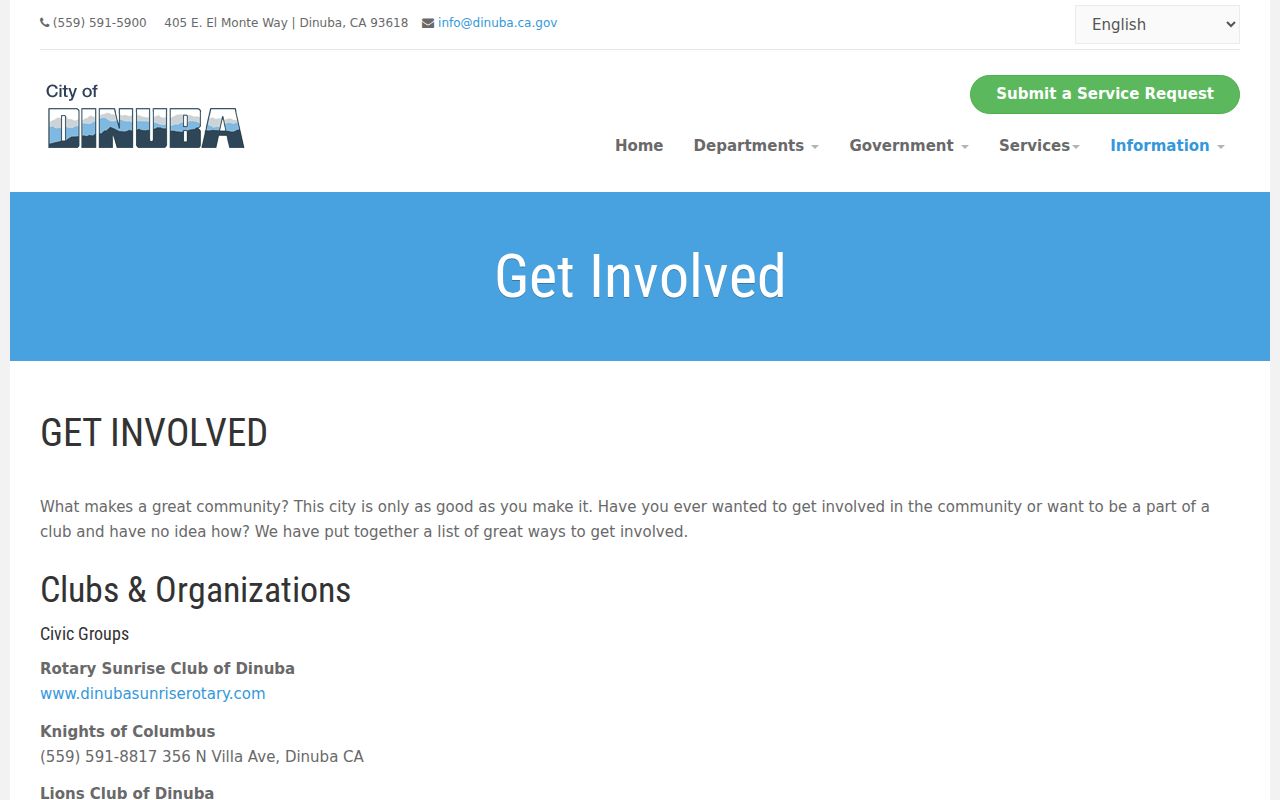
The civic inventory adds a respectful way to meet the community, while keeping the distinction clear: an organization can help someone connect locally, but it does not verify a household address or publish a member roll.
Past Dinuba Neighbors on a Block
A block can be studied across time without pretending that an old directory is a current list. The Tulare Public Library Genealogy Room inventory includes countywide volumes from 1888, 1904-05, 1908-09, 1930-33, and selected Polk's Tulare County runs from 1934 through 1958. Each book must be checked for town coverage. A county title alone does not prove that a particular Dinuba street appears inside it, and no confirmed digitized Dinuba directory entry was located.
For an earlier block, compare a verified street section with the Dinuba Advocate, which runs 1907-15, the Dinuba Daily Sentinel, which runs 1929-34, or the Dinuba Sentinel, which runs 1909-2018. Census schedules released through 1950 can add household relationships. The 1890 California schedules were lost, so a blank year needs a gap note rather than a claim that the block was empty. Library of Congress Sanborn catalog records for editions from 1891, 1898, 1903, 1907, 1925, and the corrected set through 1944 show building footprints, uses, and street continuity, not occupants.
A focused historic block sequence is one address → one verified street section → census year → newspaper notice → parcel or deed record. A missing directory entry may reflect a move, a missed canvass, a boundary change, or a volume that did not cover Dinuba. Keep the date on every clue, then stop when the evidence shifts from a historical presence to an unsupported current claim.
Safe at Home and Dinuba Records
California's Safe at Home program can protect future address use for qualifying survivors of domestic violence, stalking, sexual assault, trafficking, child abduction, and elder or dependent-adult abuse. The program supplies a designated address, mail forwarding, an agent for service of process, and confidential voter registration. It is a safety program, not a general anonymity product, and an ordinary parcel search should stop when a protected record or substitute address appears.
The Secretary of State's Safe at Home FAQ explains the program's address-substitution rules.
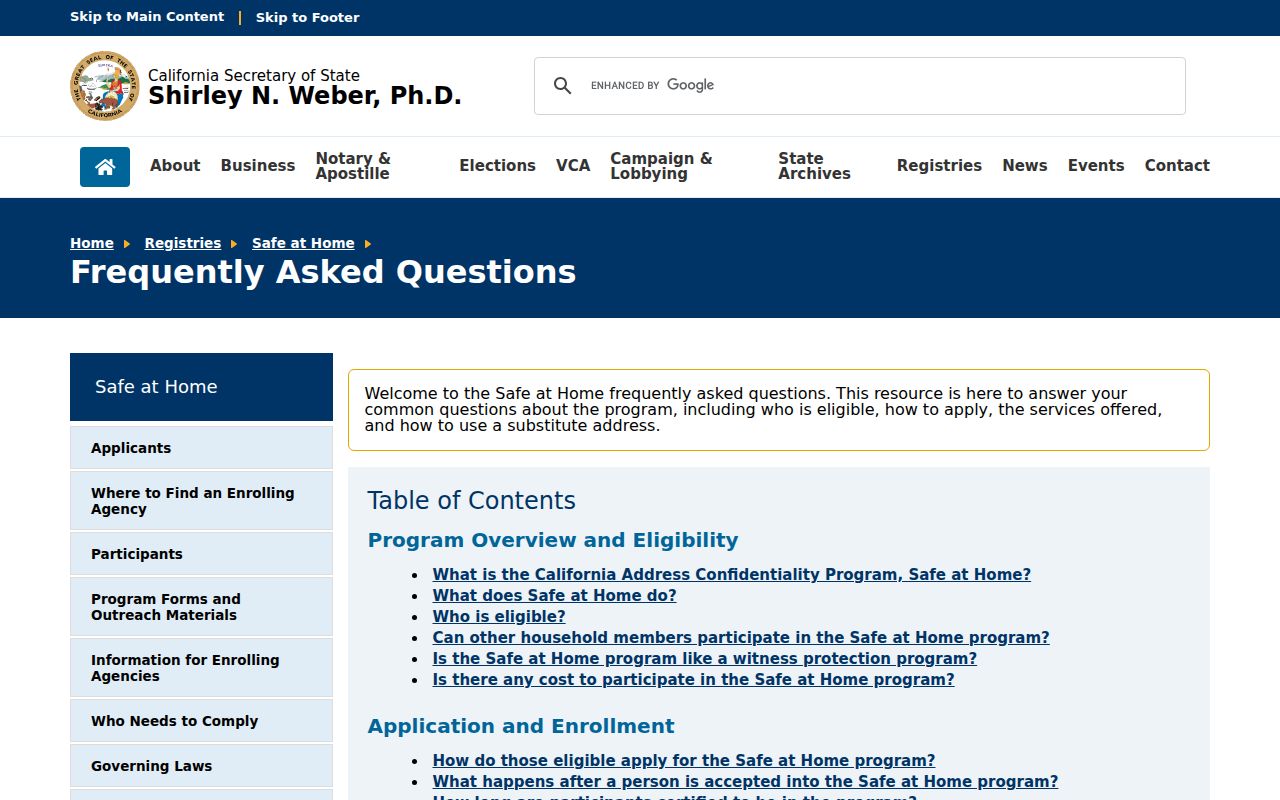
Government Code §§6205-6216 govern the program, and §6209.5 supports substitution on deeds, changes of ownership, and deeds of trust in qualifying situations. Safe at Home cannot erase public information already published. Do not use an old address, a deed, or a map to work around a protected current address. A source correction belongs with the custodian that created the record.
Choosing Tools for Dinuba Neighbors
Official rolls and commercial tools serve different purposes. County systems preserve a source record and its limits. Commercial compilation tools may blend public data, supplied data, and old address links, so a result can be stale, merged with a namesake, or hidden behind a subscription. A commercial result is only an uncited lead. Confirm an important fact through the office or organization that holds the record.
| Source type | Useful signal | Limit to keep in view |
|---|---|---|
| GIS and assessment roll | Parcel shape, APN, situs, characteristics, and current document bridge | Not an owner-name or household list; no radius owner report |
| Recorder index and image | Recorded parties, dates, instrument types, legal descriptions, and copies | Shows transactions, not current occupancy; older access may be counter or microfiche |
| Voter and civic sources | Self-status, approved election data, or organization contact routes | Purpose limits apply, and civic pages do not publish private member rosters |
| Commercial neighbor tools | Possible lead across mixed public and supplied datasets | May be wrong, dated, blended, or paid; verify without republishing a private detail |
Tulare County warns that private mailers may charge $100-$500 for records or services available free or at a nominal public fee. Check an official index and call the custodian before paying a solicitation. California's current privacy action addresses a separate problem: data brokers that copy and resell personal details.
The state’s California DROP platform lets a resident send one deletion request to more than 600 registered brokers. It launched January 1, 2026; broker processing began August 1, brokers check at least every 45 days, and matched data is generally deleted within 90 days. DROP uses hashed identifiers and returns a tracking ID. Matching can fail, exceptions can apply, and deletion does not correct the county's source record.
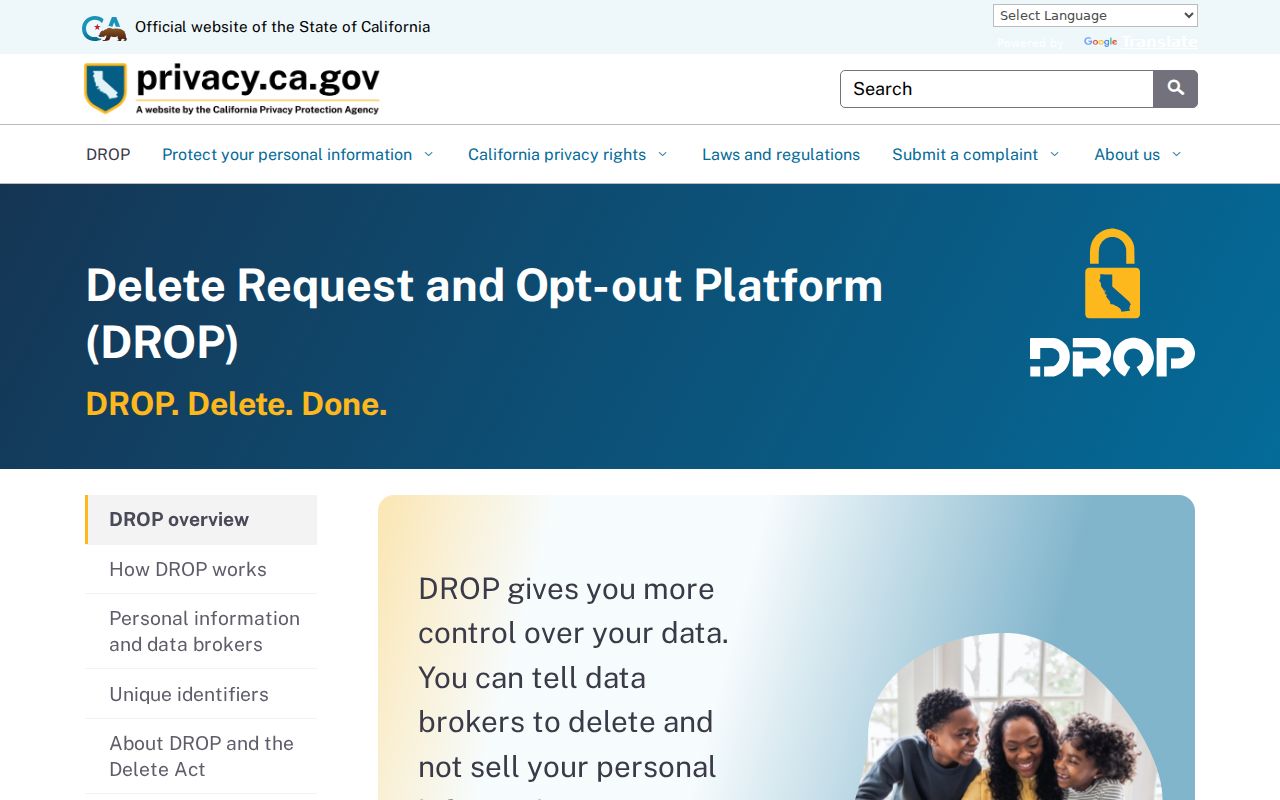
Use the DROP result as a privacy task with a date and confirmation number, not as proof that every copy of a Dinuba address has vanished. Correct parcel, court, license, voter, or recorder errors with the custodian first, then track downstream deletion separately.
Where a Dinuba Lookup Stops
The strongest block research stays narrow. Map only the parcels that touch the chosen parcel, label the APN and source date, and keep ownership separate from occupancy. Do not infer a household from a tax field, a civic affiliation, a historic directory, or a commercial compilation. People not named in land records, household members, utility customers, delivery records, DMV addresses, sealed files, and protected voters are not open substitutes for the missing record.
Lawful use. Dinuba block lookups are appropriate for personal research, reconnecting, civic curiosity, and basic safety awareness. Do not use parcel, voter, court, civic, or commercial data to watch, threaten, stalk, harass, intimidate, or harm anyone; California law treats stalking and doxing as serious misconduct.
Penal Code §646.9 addresses stalking, while Civil Code §§1708.7 and 1708.89 address civil stalking and doxing concerns. A California Public Records Act request can seek identifiable nonexempt records, but it does not override a statutory exemption or confidentiality program. When a source returns a denial, sealed record, or protected address, record the custodian and the stated limit, then stop.
For a defensible Dinuba block result, preserve the short chain: known address → touching parcel → APN → current assessment document → recorded instrument or civic contact. Every step says what the source shows, and every gap remains a gap.